





Living longer also means rethinking the way we support people through the different stages of life, especially when mobility, independence and managing daily activities become more challenging.
Italy is one of the countries with the highest life expectancy and the oldest population in Europe. As of 1 January 2026, those aged 65 and over accounted for 25.1 per cent of the population, whilst those aged 85 and over exceeded 2.5 million (https://www.istat.it/comunicato-stampa/indicatori-demografici-anno-2025/). At the same time, the very concept of old age is changing, as the gradual increase in life expectancy brings with it the need for greater focus on preserving independence, wellbeing and quality of life even at this stage of life.
Against this backdrop, orthopaedic and healthcare shops are taking on an increasingly central role, not merely as outlets for medical devices and aids, but as local hubs where people can find expertise, advice and solutions tailored to their individual needs.
An ageing population is changing the needs for independence and care
Increased life expectancy brings with it new requirements relating to managing independence and care. Difficulties with walking, the need to make the home safer, recovery following surgery, rehabilitation or support with daily activities are situations that may require different solutions over time.
And this change does not affect only the elderly person.
In fact, a network develops around those in need of care, comprising family members, caregiver, doctors, physiotherapists, healthcare professionals and specialist retailers. Choosing an aid can therefore become part of a broader process, the aim of which is to preserve independence, safety and participation in daily life as much as possible.
Orthopaedic shops are no longer just retail outlets
But, in practical terms, what purpose do orthopaedic shops serve today? And when might it be useful to visit a specialist shop?
Depending on the type of shop and the expertise available, orthopaedic and healthcare shops can offer:
- a wide range of standard medical devices;
- the range may be accompanied by advice from qualified professionals and the customisation of certain devices;
- in some cases, they can produce bespoke medical devices when standard solutions are not sufficient.
What increasingly unites healthcare and orthopaedic shops is the gradual shift from a product-focused approach to one geared towards identifying the solution best suited to the individual’s needs.
For those who enter an orthopaedic shop, in fact, the need is not simply to ‘buy a walking frame’ or ‘choose a wheelchair’ . The question might be: how can I get about more safely? How can I maintain my independence? How can I make it easier for a family member to provide daily care?
This is precisely where the specialist orthopaedic retailer can make a difference, by helping to identify the solution that best meets the person’s needs and suits the context in which it will be used.
The importance of fitting and personalising assistive devices
When it comes to assistive devices for older people, medical devices and mobility solutions (https://en.morettispa.com/product-categories/), there is no one-size-fits-all product.
Body build, motor skills, home environment, frequency of use and level of independence are just some of the factors that can influence the choice.
A rollator intended primarily for outdoor use, for example, meets different needs to a walking frame, which is mainly used indoors. Similarly, a wheelchair must be assessed not only in terms of the person who will use it, but also the environments in which they will need to move and the needs of their carers.
It is not just a question of which product to choose, but also of understanding how to integrate each device correctly into the user’s daily life. This is why trying out the aid, receiving professional advice and assessing any possibilities for customisation are key benefits of the specialist retail channel.
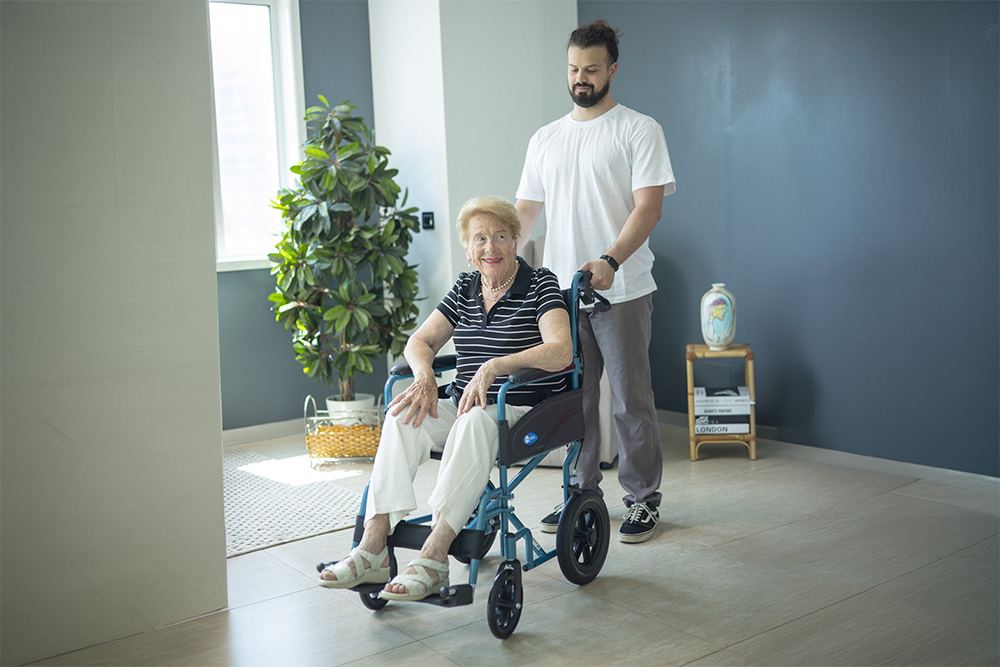
A network involving professionals, carers and retailers
Personal care is increasingly less likely to be the responsibility of a single point of contact.
The doctor identifies a clinical need, the physiotherapist supports the recovery process, the specialist retailer assists with the selection and use of the aid, and the carer deals with the person’s practical needs on a daily basis.
The orthopaedic and healthcare sectors can therefore act as a link between needs, solutions and expertise. By listening to individual requirements, they transform requests into practical solutions for everyday life: they identify the most suitable assistive devices for both the user and their carer, ensuring ongoing support in the management and correct use of the equipment.
Why choose a specialist orthopaedic retailer
The availability of products online has greatly expanded the range of choices. When it comes to medical devices and aids designed for health, mobility and care, however, the sheer number of alternatives does not necessarily mean you can identify the most suitable one.
The value of a specialist shop lies precisely in its ability to complement product availability with a range of services: listening to your needs, providing advice, allowing you to try products, offering guidance on correct use and, where applicable, customisation and after-sales support.
These aspects are particularly important when the aid is intended for daily use or when your needs may change over time.
The retailer’s specialisation therefore becomes an integral part of the value of the solution itself.
Moretti S.p.A.: supporting the orthopaedic and healthcare sector
To ensure that orthopaedic and healthcare providers can meet increasingly diverse needs, it is essential to be able to rely on a wide and varied range of products and aids, capable of addressing different requirements in terms of mobility, independence, care and everyday living.
It is within this ecosystem that Moretti S.p.A. operates, having specialised for 50 years in the development and distribution of medical devices and home care solutions.
We complement the breadth of our catalogue with ongoing support for retailers: an extensive sales network covering the whole country, continuous training for the sales force, and a dedicated technical and after-sales support service.
This creates a synergistic supply chain in which the manufacturer, retailers and healthcare professionals work together to tangibly improve people’s quality of life.
Orthopaedic and healthcare shops: advice, innovation and local presence
Demographic trends make it clear that independence and the quality of care will become increasingly important issues in the coming years.
At the same time, technologies, materials, devices and the needs of users and carers are changing. And as the range of options available increases, so too does the value of those who can guide people in their choices.
Orthopaedic and healthcare shops will increasingly cease to be mere places to buy products and will instead become spaces where professional expertise and solutions come together to meet people’s individual needs.
This transformation reinforces the role of the local orthopaedic shop and its contribution to an increasingly important goal: helping people to maintain their independence and quality of life.