





From hospital wards to community settings, right through to emergency care: what do doctors today look for in a pocket-sized ultrasound device, and how is the market evolving to meet their needs?
Traditional ultrasound is no longer enough
For decades, the ultrasound scanner was a fixed, bulky and expensive piece of equipment, housed in dedicated rooms and usable only by bringing the patient to the diagnostic station. Today, however, the needs of medicine have changed. Increasingly, it is the machine that must follow the doctor, adapting to different healthcare settings.
There are many reasons for this. Hospital wards operate under pressure: shifts are intense, patient numbers are high and time is short. A doctor making their rounds cannot afford to interrupt their workflow every time they need a quick ultrasound scan. Similarly, an A&E doctor managing a trauma case does not have time to wait for a report from a dedicated sonographer.
Outside the hospital, the situation is even more evident. General practitioners, paediatricians and professionals healthcare working in outlying facilities or in community screening programmes need tools that are quick, practical and easily portable, without having to rely on complex infrastructure or dedicated workstations.
The fact is simple: ultrasound remains an immensely valuable diagnostic tool, but its traditional use has remained tied to a model that no longer fits the operational reality of modern medicine.
The evolution: point-of-care ultrasound and wireless probes
The market’s response to this need is known as point-of-care ultrasound (POCUS): an approach that enables the ultrasound scan to be carried out directly wherever the patient is, when it is needed, by the healthcare professional treating them.
Technological advances in recent years have made possible what once seemed unthinkable: ultrasound probes the size of a remote control, with a built-in battery, wireless connectivity and professional-grade image quality. These devices fit in your pocket, connect to devices such as tablets and smartphones, and are ready for use in a matter of seconds.
This change is not merely technological — it is a clinical paradigm shift. The ultrasound scanner is no longer a piece of equipment that needs to be booked in advance; it has become an extension of the doctor, available in any setting: the ward, the ambulance, the field or the surgery.
Portability thus opens up new operational possibilities:
- it reduces waiting times for scans;
- it simplifies travel;
- it promotes continuity of care;
- it brings ultrasound closer to the point of care.
How to choose a professional portable ultrasound probe
Not all pocket-sized probes are the same. To meet the real needs of healthcare professionals, a device of this kind must meet a number of specific criteria.
Image quality. Compactness must not compromise the diagnostic quality of the images. Today’s most advanced imaging platforms utilise tissue-adaptive technologies capable of automatically optimising acquisition parameters. A good portable probe must support B, C, M and PW modes and ensure that the images are comparable to those produced by larger systems.
Battery life and durability. A device designed for fieldwork must last at least one shift, recharge quickly and be resistant to dust and liquids. IP67 certification is now regarded as the benchmark standard for use in hospital and pre-hospital settings.
Intelligent automatic functions. The most advanced portable probes do more than simply display images; they can incorporate automatic functions designed to assist the clinician during the examination. Assisted measurements, clinical presets, tools for counting pulmonary B-lines, assessing bladder volume, analysing carotid intima-media thickness or tracking PW waves can help to make the examination faster, more standardised and more reproducible.
These functions do not replace the practitioner’s expertise, but can complement it, reducing operator-dependent variability and facilitating the assessment process.
Integration into the hospital workflow. In hospital settings, it is essential that the probe integrates with the facility’s information system. PACS compatibility, DICOM support and the ability to export images and videos are essential requirements for any professional application.
Ease of use in an emergency. In critical situations, every second counts. The best tools offer dedicated emergency protocols — such as FAST, eFAST and the BLUE protocol for pulmonary assessment — accessible at the touch of a button, without the need for manual configuration.
Customisation and training. Professionals must be able to adapt the device to their own workflow — by configuring the probe’s physical buttons, clinical presets and annotations. They must also be able to train staff easily, ideally using a tutorial system integrated directly into the application.
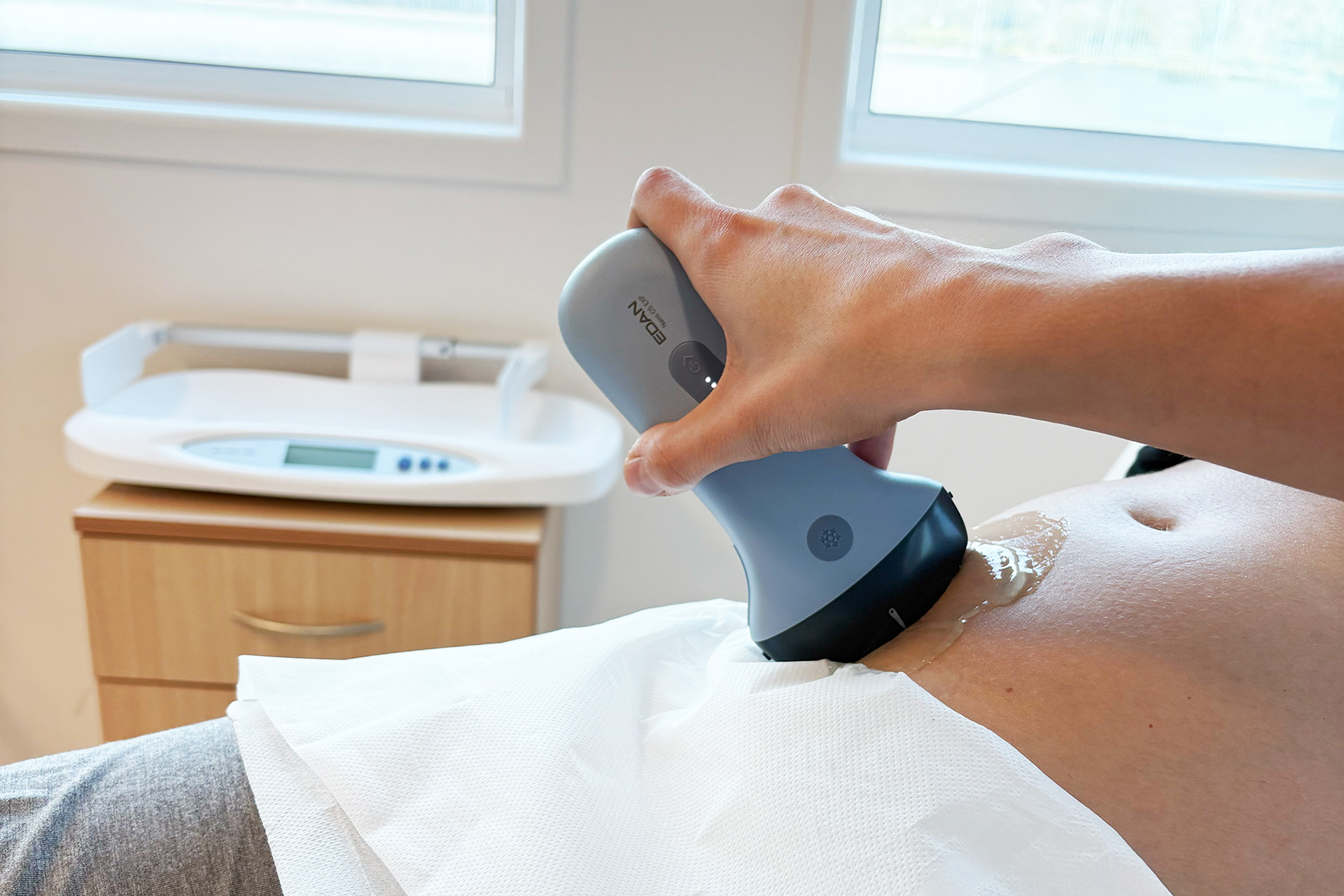
Where portable ultrasound is used
The value of portable ultrasound is particularly evident in situations where speed, mobility and ease of access to the device make all the difference.
In a hospital setting, it can assist doctors with bedside assessments, on wards, in A&E or in situations where additional clinical information needs to be obtained quickly.
In the local area, however, it can become a useful tool for making ultrasound more accessible to patients: in doctors’ surgeries, specialist clinics, outlying facilities, home care settings or screening programmes.
The different configurations available enable the device to meet a range of clinical needs. Convex transducers are particularly suitable for abdominal, gynaecological, obstetric and general examinations; linear transducers, on the other hand, are used in vascular, musculoskeletal and general examinations, as well as in guided procedures.
This versatility makes the portable ultrasound scanner a cross-disciplinary solution, capable of being used across many specialities without necessarily replacing traditional ultrasound systems, but complementing them where a more immediate, compact and flexible tool is required.
Conclusion
Point-of-care ultrasound (POCUS) is no longer a niche interest for technology enthusiasts. It is a practical solution to a real clinical need: to have rapid, compact and readily available tools across different healthcare settings.
From hospital wards to community settings, from A&E to outpatient clinics, pocket-sized ultrasound probes are helping to make imaging more accessible, flexible and closer to the patient.
Their role is not to replace traditional ultrasound systems, but to complement them, by extending the scope of ultrasound use and providing healthcare professionals with a practical tool to integrate clinical assessment exactly when it is needed.