




From discharge from hospital to transfer to a care home, right through to the start of home care: the setting for care may change, but there may still be a need to monitor the patient’s condition over time.
In such cases, continuing to monitor vital signs can help healthcare professionals to identify any clinical changes promptly, thereby supporting continuity of care and the assessment of the patient even outside hospital.
Post-hospital monitoring: new organisational requirements
During hospitalisation, monitoring takes place in an environment designed to ensure immediate access to equipment, power supplies and healthcare staff.
Following discharge, the settings, the frequency of checks, the methods of care provision and the availability of equipment all change. In care homes, the device may need to be used in different rooms or wards; in home care, it must accompany the care professional during multiple visits, adapting to different contexts each time.
Post-discharge monitoring therefore does not involve replicating the organisation of a hospital ward in the community, but rather defining monitoring methods consistent with the individual’s condition, the care plan and the procedures of the facility or service.
The first signs of clinical deterioration following discharge
A deterioration in a patient’s condition does not always present as a sudden, easily recognisable event.
Sometimes it may begin with more subtle changes: an unusual respiratory rate, a drop in oxygen saturation, a change in blood pressure, or an alteration in heart rate or temperature.
A single reading is not sufficient to describe the patient’s overall clinical condition. However, it becomes more meaningful when interpreted alongside other parameters, compared with previous readings and considered within the context of the patient’s overall condition.
This is precisely why, in the most vulnerable patients, multi-parameter assessment over time can provide more reliable information than the occasional measurement of a single parameter.
Monitoring patients in care homes: early recognition of clinical deterioration
Care homes provide care for people with very different levels of independence and clinical complexity.
In some cases, the first sign of possible deterioration is not a significantly altered vital sign, but a change in the resident’s usual behaviour: increased drowsiness, confusion, reduced appetite, breathing difficulties, weakness or reduced interaction.
Daily observation by care staff therefore remains essential.
This direct knowledge of the individual can be complemented by the monitoring of vital signs, which is useful for documenting changes and communicating more comprehensively with the doctor and other healthcare professionals.
Technology does not replace the care worker’s experience, but it can help transform an initial concern into more structured and shareable information, providing objective evidence to confirm a suspicion, monitor its progression over time and share more comprehensive information with the doctor.
Monitoring patients at home: portable devices for continuity of care
Home care also has its own specific requirements. Home visits are generally scheduled, and healthcare professionals must work in environments where a dedicated workstation is not always available.
In this context, the portability of the device takes on particular importance.
During a home visit, healthcare professionals often have to assess patients within a limited timeframe and in a wide variety of settings. Having a portable device capable of measuring multiple parameters allows professionals to gain a more comprehensive understanding of the patient’s condition, without necessarily having to use several separate devices.
This does not mean that every discharged patient must undergo continuous monitoring. Depending on clinical and organisational needs, periodic measurements or forms of more prolonged observation may be used.
From a single parameter to a multi-parameter assessment
Sphygmomanometers, pulse oximeters and thermometers remain essential tools in community settings. In some situations, however, it may be useful to measure multiple parameters using a single device.
There are, however, situations in which measuring a single parameter may not provide a sufficiently comprehensive picture.
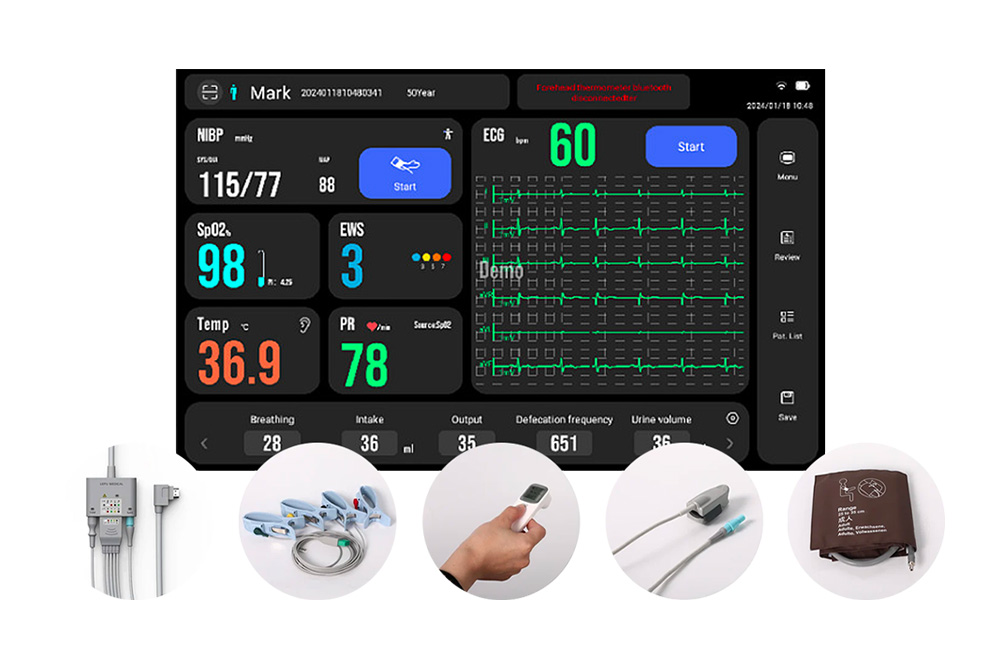
A multi-parameter monitor allows this information to be brought together on a single interface, making it easier to read the main vital signs simultaneously.
The advantage lies not simply in having more figures available, but in being able to view them together and compare them over time, thereby reducing the risk of interpreting a single value out of its clinical context.
Early Warning Score (NEWS2): a tool to aid patient assessment
When multiple parameters are collected in a structured manner, early warning systems such as the Early Warning Score can be utilised.
These tools assign a score to various physiological values and provide a concise indication that can help highlight a situation potentially requiring greater attention.
Systems such as NEWS2 take into account parameters such as respiratory rate, oxygen saturation, systolic blood pressure, heart rate, temperature and level of consciousness.
It is necessary to define in advance:
- which patients to monitor;
- which parameters to collect and at what frequency;
- who is authorised to interpret the score;
- which thresholds require re-assessment;
- who to contact in the event of an abnormality;
- how to document the actions taken.
The presence of the score on the device is therefore not sufficient: its value depends on the clinical and organisational process within which it is used.
Which devices to choose for post-hospital care settings
To be truly useful in post-hospital monitoring, a device must be suited to the care setting in which it is used.
Whether in a care home, a halfway house or during home care, it is not just a question of which parameters can be measured.
Compactness, ease of transport, speed of use, clarity of data display and the ability to collect multiple pieces of information via a single device are also important.
In a residential care home, the device may need to be moved between different rooms. In home care, it must be able to accompany the carer without becoming a logistical hindrance.
It must also fit into clear operational procedures: which patients to monitor, how often, who should interpret the data, and when it is necessary to contact the doctor or escalate to a higher level of care.
The technology must adapt to the care pathway, not complicate it.
Continuity of care: the value of monitoring after discharge
Extending monitoring to care homes or during home care does not mean replicating the intensity and organisation of a hospital ward in the community. It means recognising that some patients continue to require structured monitoring even after discharge.
In these contexts, multi-parameter monitoring can complement the experience of care staff, help to document changes and ensure more comprehensive communication between the various professionals involved in the patient’s care.
Ensuring monitoring after discharge means promoting greater continuity of care between the hospital, care homes and the patient’s home. The structured monitoring of vital signs can help healthcare professionals track the patient’s clinical progress, identify any changes promptly and support more informed care decisions. This is why monitoring does not end with discharge: it adapts to the new care setting, continuing to support the patient’s journey.